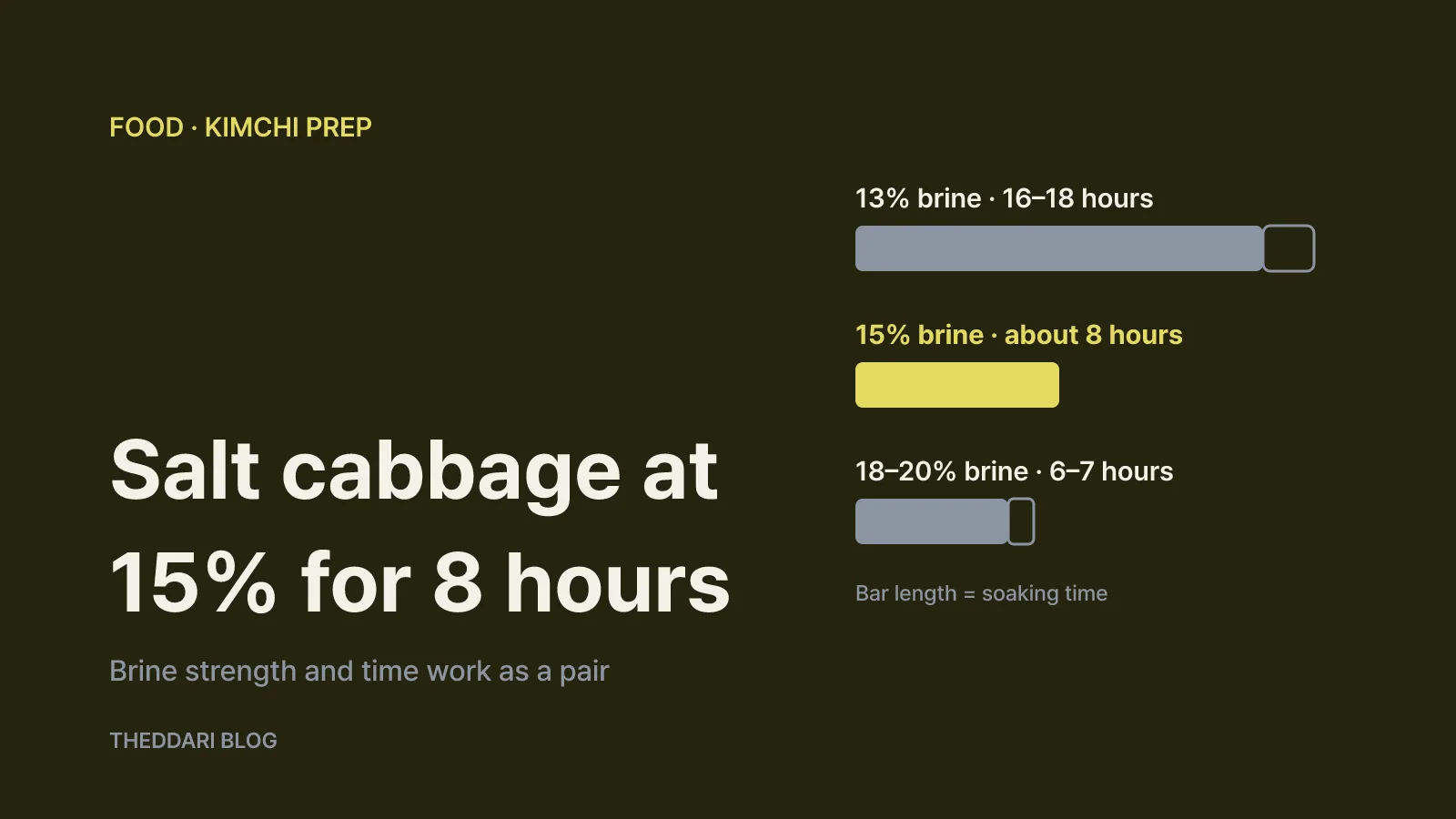
As of November 2026, the most widely cited Korean public guidance for salting napa cabbage for kimchi is simple: soak the split heads in roughly 15% brine for about 8 hours. That is the method shown by Korea's Rural Development Administration on its Nongsaro farming portal. The World Institute of Kimchi FAQ adds two alternative pairings: 13% brine for 16–18 hours, or 18–20% brine for 6–7 hours. The rule that matters most is that strength and time travel together. Pick one row and follow it, then rinse the cabbage two or three times in cold water and drain it cut side down. Below you will find how to mix the brine by weight, how to tell when the leaves are done, and how to handle pre-salted cabbage bought from a store.
Brine strength and soaking time are a matched pair
Recipes online quote anything from six hours to a full day. Most of that spread comes from different brine strengths and methods. A stronger brine pulls water out of the leaves and lets salt in faster, so the soak is shorter. A weaker brine needs more time. Mixing the concentration from one recipe with the timing from another is the most common reason home kimchi ends up either salty or limp and underseasoned.
The combinations published by Korean public institutions are:
← Swipe to see more
| Brine strength | Soaking time | Source |
|---|---|---|
| About 15% | About 8 hours | Rural Development Administration (Nongsaro) |
| 13% | 16–18 hours | World Institute of Kimchi |
| 18–20% | 6–7 hours | World Institute of Kimchi |
For a first batch, 15% for about 8 hours is the easiest to schedule: start in the evening and rinse the next morning. The 13% option suits a longer overnight soak that runs into the next day. The 18–20% option is fast, but a short delay can push the cabbage from seasoned to salty, so choose it only if you can watch the clock.
How much salt makes a 15% brine?
Brine percentage is normally calculated as salt weight ÷ (water weight + salt weight). A kilogram of 15% brine is therefore 150 g of salt plus 850 g of water. Adding 150 g of salt to a full liter of water actually gives you about 13%, because the total weight becomes 1,150 g.
Per liter of water (about 1 kg), the math works out like this:
← Swipe to see more
| Target strength | Salt per 1 L water | Salt per 10 L water |
|---|---|---|
| 13% | about 149 g | about 1.49 kg |
| 15% | about 176 g | about 1.76 kg |
| 18% | about 220 g | about 2.2 kg |
| 20% | 250 g | 2.5 kg |
These values follow directly from the definition above. Coarse Korean sea salt varies a lot in crystal size, so a cup of one salt can weigh noticeably more or less than a cup of another. Use a kitchen scale rather than volume measures, and stir until no salt remains on the bottom of the tub. If you own a salinity meter, check the brine once it has dissolved.
Step-by-step: the Nongsaro salting method
The Nongsaro video, produced with Korea's National Institute of Agricultural Sciences, walks through the process in this order:
- Trim. Remove the tough, damaged outer leaves and slice off the root end.
- Split. Cut a slit only at the root end, then pull the head apart by hand. Cutting all the way through the leaves makes the inner leaves fall apart later when you slice the kimchi.
- Dip. Fill a large, wide tub with about 15% brine. Submerge each piece once and lift it out.
- Salt the stems. As you move the pieces into a second tub, scatter coarse salt between the thick white stems. The ribs are much thicker than the leafy tops and absorb salt more slowly.
- Stack and pour. Layer the cabbage neatly and pour the original brine back over it.
- Wait about 8 hours. Turn the pieces once or twice so every layer stays submerged and salts evenly.
Skipping the turn usually leaves the top layer underdone and the bottom layer too salty. If pieces float, press them down with a clean plate or a container filled with water. Nongsaro also warns that leaving cabbage in brine for too long harms the flavor of the finished kimchi, so move on when the time is up.
Where you salt matters too. The World Institute of Kimchi notes that salting time, brine strength and brine temperature all affect softening, and advises avoiding salting at high temperatures while keeping strength and time fixed. In practice that means a cool porch, garage or unheated room rather than a warm kitchen next to the radiator.
How to tell when the cabbage is properly salted
The clock gets you close, but heads differ in size and density. The World Institute of Kimchi explains that a consistent brine strength and temperature give similar results each time, yet small adjustments are still needed depending on how tightly packed and how large the heads are.
- The bend test: fold the thickest outer rib. If it bends smoothly instead of snapping, the cabbage is ready. If it still snaps, give it a little longer.
- The taste test: chew a piece of rib. Seasoning should reach the white stem, not just the green leaf.
- The salinity target: the institute puts salted cabbage at 1.5–2.0% salt, with the seasoning paste slightly higher at 2.1–2.2%. A salinity meter on a rinsed rib will tell you whether you are in range.
Going too low has its own cost. According to the institute, kimchi softens when its salt level is low (2% or below), when it is stored warm, or when it is exposed to air. Rather than shortening the soak to cut salt, keep the chosen time and adjust saltiness during rinsing. The same source gives a typical cabbage-to-paste ratio of 80:20, moving to 75:25 for kimchi meant to be eaten soon and using less paste for long-keeping batches.
Rinse two or three times, then drain for 3–4 hours
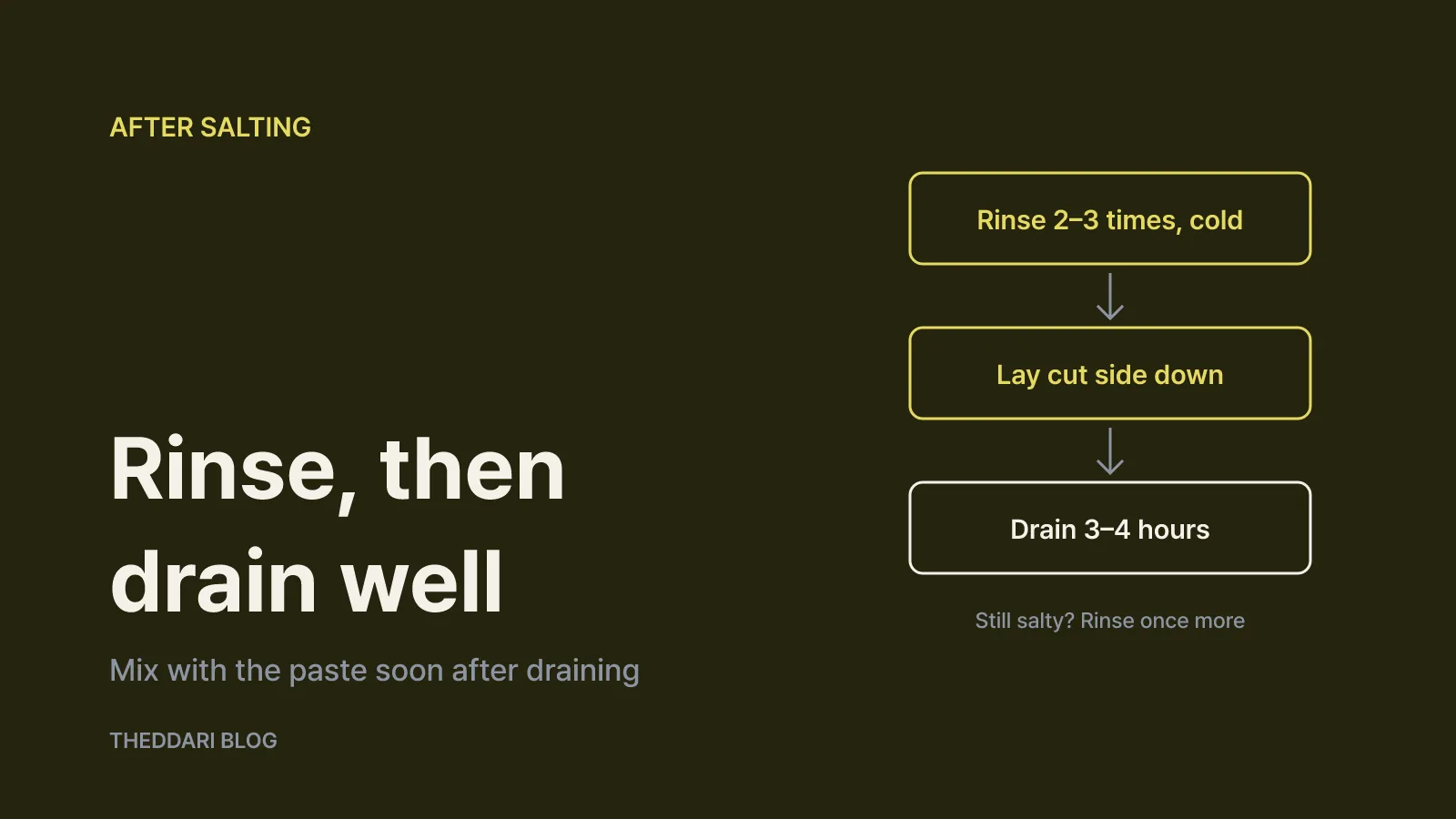
Rinse the salted cabbage two or three times in plenty of cold water, as Nongsaro recommends, to avoid damaging the leaves. Swish rather than scrub, shaking out grit and leftover salt from between the ribs. Taste a rib afterward; if it is still too salty, rinse once more.
Drain the pieces cut side down in a large colander or basket. For timing, the World Institute of Kimchi notes that regular kimchi uses 3–4 hours of draining, while long-aged kimchi (mukeunji) is drained for 24 hours to reduce liquid. For a standard batch, plan on 3–4 hours and extend it only if water is still dripping steadily. Too much water left in the leaves dilutes the paste and floods the jar with brine.
Fermentation starts once salt meets cabbage, so have your paste ready and mix soon after draining rather than leaving the cabbage sitting out.
Buying pre-salted cabbage: same-day use and the three-wash limit
Many Korean households now order ready-salted cabbage (jeolim baechu), and some Korean grocers abroad sell it during kimjang season. Korea's Ministry of Food and Drug Safety advises using it on the day it arrives, because coliform bacteria, a hygiene indicator, can increase if it sits at room temperature for a day or more.
If it has been at room temperature for over a day, wash it before use. In the ministry's test, about three washes cut total bacteria by 95% and coliforms by 93% compared with unwashed cabbage. More washing can damage the leaves, so the ministry recommends not going beyond three. Its method:
- Submerge the cabbage in water.
- Gently rub the root area and between the leaves with your fingers.
- Rinse twice with clean water.
If kimchi day slips, the World Institute of Kimchi found that salted cabbage kept its quality when submerged in about 2% brine at 0°C (32°F) and packed airtight. At −3°C (about 27°F) it froze. Treat this as a lab storage result and aim to make your kimchi as soon as possible.
Common mistakes to avoid
- Treating 150 g per liter as 15%. That is about 13%. Use about 176 g per liter for a true 15%, or switch to the 16–18 hour timing for 13%.
- Mixing recipes. A full day in 15% brine or only 8 hours in 13% gives salty or undersalted cabbage. Follow one row of the table.
- Never turning the pieces. Set a reminder to flip them once or twice.
- Salting somewhere warm. Heat contributes to soft, mushy kimchi.
- Reusing brine. Kimchi factories do reuse brine, but the institute says research on the quality of cabbage salted in reused brine is still limited, and reported problems include sour odors, dark brown color and heavy foaming. At home, mix fresh brine.
- Over-washing store-bought salted cabbage. Three washes is the ceiling.
Once the cabbage is salted, rinsed and drained, temperature control during fermentation and storage takes over as the deciding factor in how your kimchi turns out.