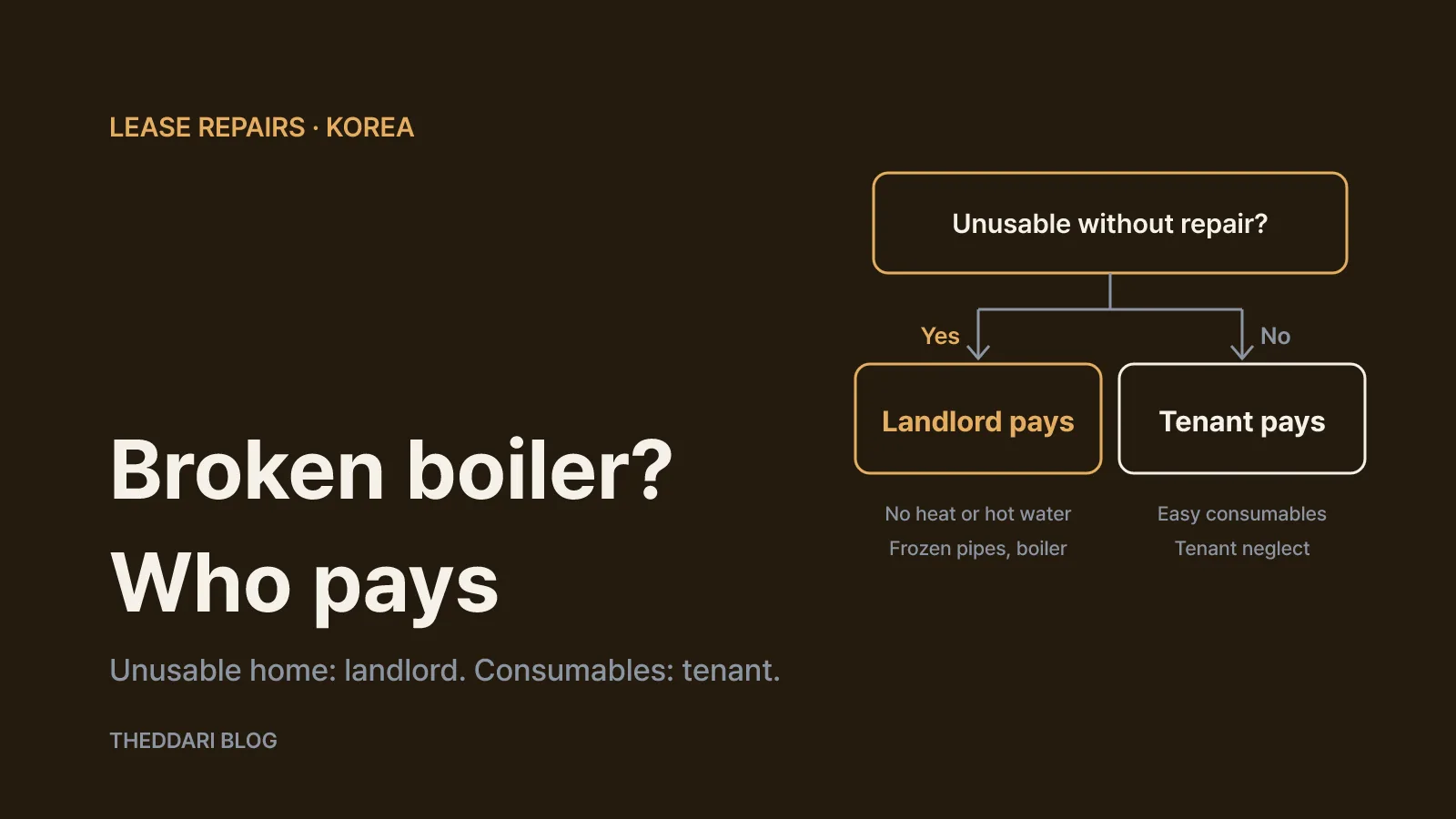
As of November 2026, the short answer for anyone renting a home in Korea, on jeonse or monthly rent (wolse), is this: if your boiler breaks down or a pipe freezes and you can no longer heat the home or get hot water, repairs are normally the landlord's responsibility. You pay for small consumables that are cheap and easy to replace, such as a thermostat battery or a light tube, and for damage caused by your own neglect or carelessness. The deciding question is not how big the repair bill is, but whether the home can still be used for its purpose without the fix. This guide walks through the Korean Supreme Court test, the Civil Act articles behind it, guidance from the Ministry of Land, Infrastructure and Transport, and the practical steps to get a repair done and recover your money.
The test: can you still live there without the repair?
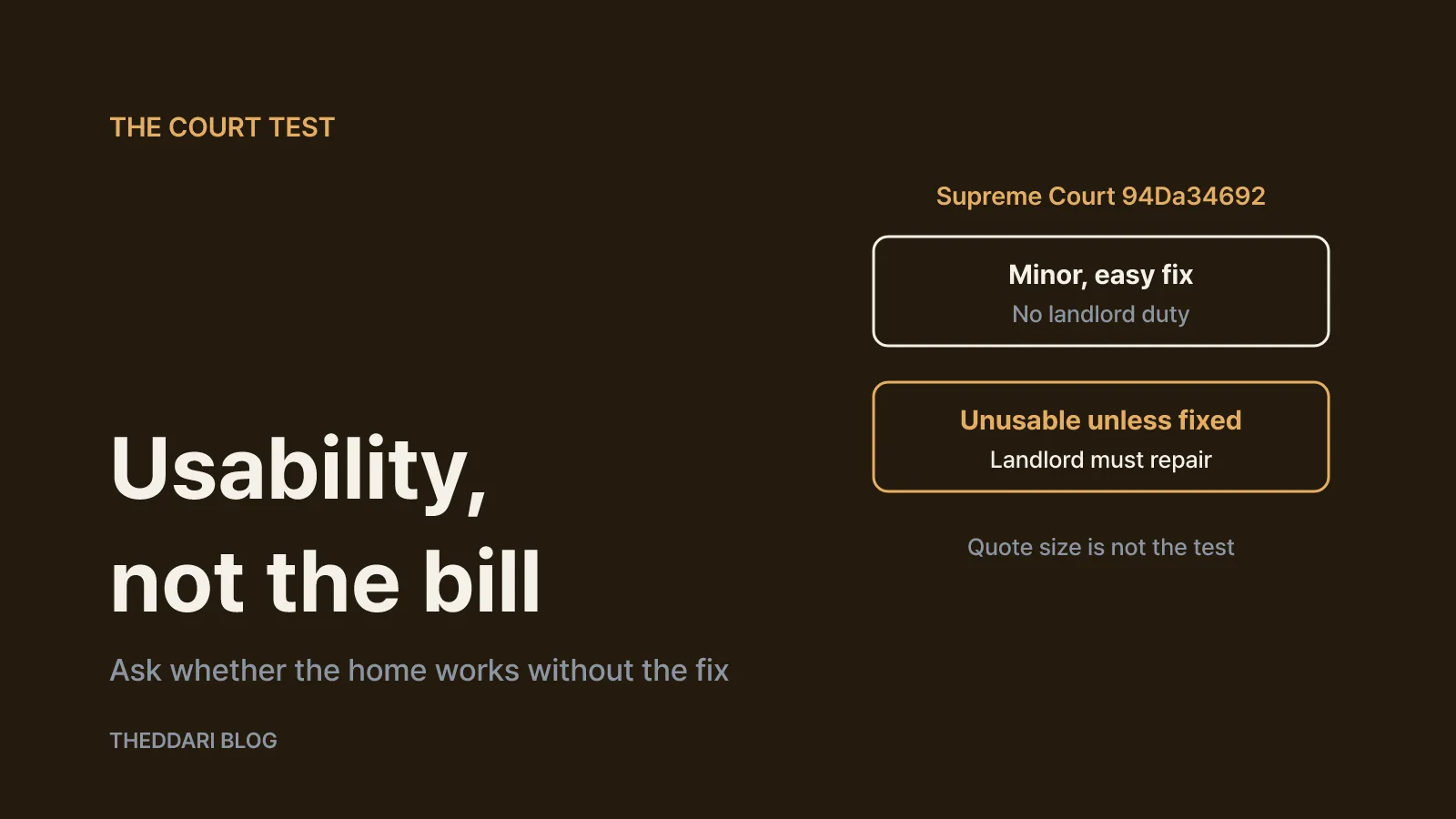
Article 623 of Korea's Civil Act requires a landlord to keep the rented property in a condition fit for use throughout the lease. This is usually called the landlord's duty to repair. Where that duty starts and stops was set out by the Supreme Court ruling of December 9, 1994 (cases 94Da34692 and 94Da34708), which Korean courts and public guidance still rely on.
The ruling draws two lines:
- If damage is so minor that the tenant could fix it easily without much expense, and it does not interfere with using the property, the landlord has no duty to repair it.
- If leaving the damage unrepaired would make the property unusable for the purpose agreed in the lease, the landlord must repair it.
Heating and hot water are basic functions of a home in a Korean winter. A boiler that stops producing heat, or a burst pipe that cuts off water, falls on the landlord's side of that line. The 1994 case itself involved burst pipes and a failing boiler that stopped hot water and heating, and the court treated the pipes and boiler as major structural parts or basic facilities of the building.
Notice that cost is not the test. A cheap quote does not automatically make the repair yours, and an expensive one does not automatically make it the landlord's. What matters is how much of the home you lost the use of, and for how long. That is why the first thing to do when something breaks is to take dated photos.
Boilers, frozen pipes, leaks and consumables
The Ministry of Land, Infrastructure and Transport's guidance, published on the government's Korea.kr briefing site, turns the court test into everyday examples:
← Swipe to see more
| Situation | Who normally pays | Why |
|---|---|---|
| Boiler fails from age and heating stops | Landlord | Basic facility needed to use the home |
| Boiler damaged by a natural disaster | Landlord | No fault on the tenant |
| Frozen pipe leaves you without hot water | Landlord | Home becomes unusable |
| Cracked sink or toilet, not the tenant's fault | Landlord | Basic facility |
| Built-in fridge, air conditioner or gas stove fails from age | Landlord | Included in the lease |
| Replacing a fluorescent light | Tenant | Consumable |
| Breakdown caused by tenant neglect or carelessness | Tenant | Tenant's responsibility |
| Adding new window bars or a digital door lock | Tenant, no claim | A new installation, not a repair |
Frozen pipes are where disputes cluster. The ministry says the landlord should fix a freeze that cuts off hot water, but the same guidance says tenants are responsible for breakdowns caused by their neglect or carelessness. If a cold snap was forecast and you left the home empty for a long period with the heating switched off completely and a window open, a landlord may argue that your handling caused the freeze. If the pipes were old and poorly insulated, or the building's layout exposed them, the case for treating it as the landlord's facility problem is stronger. Ask the repair technician to note the cause in writing.
Leaks from upstairs work in a similar way. If water from the unit above damages your home and the tenant upstairs was not at fault, the ministry notes that you can claim damages from the owner of that unit, who carries the repair duty there. Tell your own landlord first, but expect the matter to move to the upstairs owner if that is where the leak began.
Consumables are the clearest category. Batteries for the boiler controller, bulbs and fluorescent tubes are normally yours. But calling something a "part" does not make it a consumable. If an internal boiler component fails and the heating stops, apply the court test and ask whether the home is still usable.
What if the lease says the tenant pays for all repairs?
Many Korean lease contracts include a special clause such as "all repairs are the tenant's responsibility." The Supreme Court accepts that the landlord's repair duty can be waived or shifted to the tenant by agreement, but a single broad line does not hand you every repair.
In the same 1994 ruling, the court held that unless the clause clearly spells out the scope, a tenant who accepts repair duties only takes on small repairs of ordinary wear. Major repairs, structural work on main building parts and replacement of basic facilities stay with the landlord. The lease in that case said the tenant would bear part or all of the boiler repair costs, yet the court ruled that pipes and a boiler needing full replacement were outside the clause.
When you read your own clause, check three things: whether it names specific items and limits, such as boiler replacement; whether it is only a general statement; and whether the repair you need is minor or the replacement of a basic facility. A general clause combined with a basic-facility replacement still leaves you grounds to ask the landlord to pay. When you sign or renew, agree repair responsibilities item by item, as the ministry recommends.
How to get the landlord to fix it, step by step
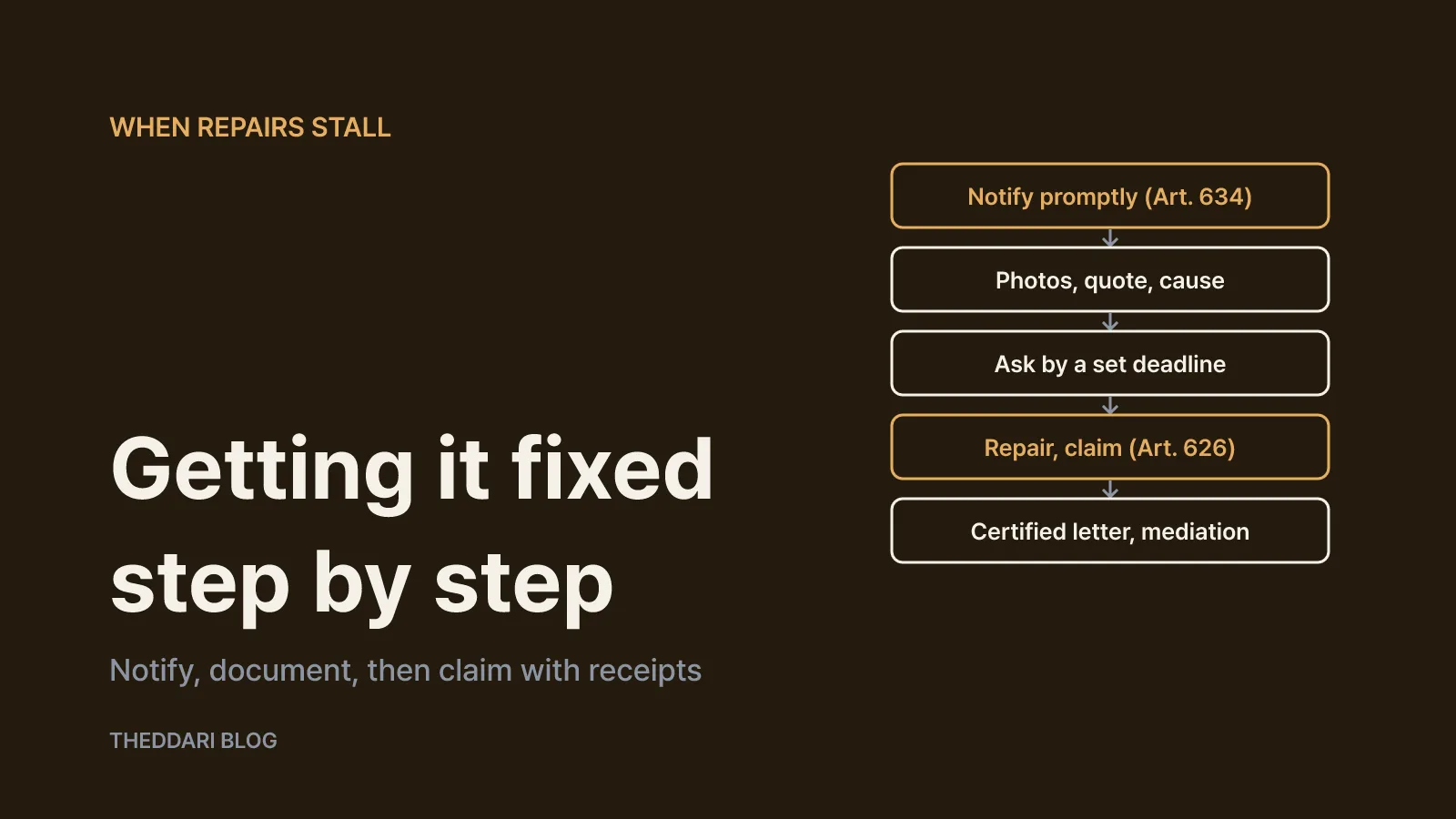
1. Tell the landlord without delay. Article 634 of the Civil Act requires a tenant to notify the landlord promptly when the property needs repair, unless the landlord already knows. Use text or a messaging app so there is a record, and include the date, the symptoms and photos. If late notice lets the damage spread, the extra damage can become a point of dispute.
2. Collect evidence. Keep photos and video of the fault, anything showing the home could not be heated, and a technician's opinion and quote. Because the cause (age or neglect) is often what the argument turns on, ask the technician to write it down.
3. Set a deadline. Winter heating failures cannot wait long. Ask for the repair by a specific date and say that, without a reply, you will arrange it yourself and claim the cost.
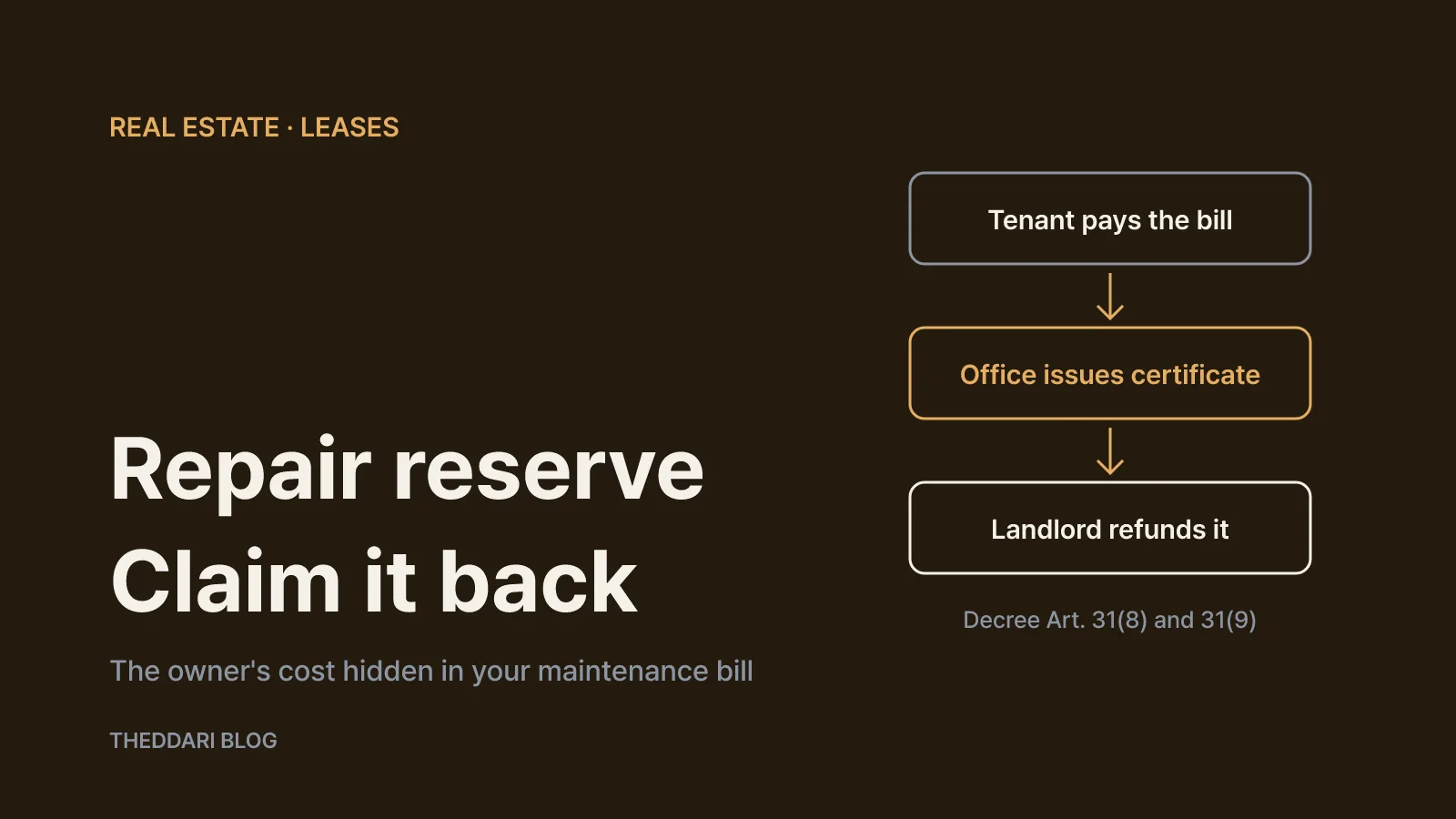
4. Repair it and claim the necessary expense. Article 626(1) of the Civil Act lets a tenant who pays necessary expenses for preserving the property claim them back from the landlord. Repairing a boiler or pipe to keep the home usable can qualify. Keep receipts, transfer records and the repair statement and send them with your claim. Improvement expenses under Article 626(2), which raise the property's value, work differently: they are settled at the end of the lease and only if the added value still exists.
5. Put it in writing and consider mediation. If messages do not settle it, send a content-certified letter (naeyong jeungmyeong) through Korea Post setting out the repair request and your claim. If that fails, look at the Housing Lease Dispute Mediation Committee or a small claims case. Deducting the cost from rent on your own, or announcing you will offset it against the deposit, can start a second dispute over unpaid rent, so try agreement or mediation first.
A pre-winter checklist for tenants
Because frozen-pipe disputes usually turn on whether the tenant was careless, a few steps before the cold arrives both prevent damage and give you evidence:
- Photograph the boiler's manufacture date and condition, and the insulation on exposed pipes and the water meter box. A record that they were already old helps if the cause is disputed.
- If you will be away during a cold snap, do not switch the heating off entirely; use an away or low setting to keep some warmth in the home.
- If exposed pipes or the meter box look poorly insulated, ask the landlord to fix it in advance, and keep that request on record.
- Report warning signs such as unusual boiler noises or dropping pressure straight away, which also satisfies the notice duty in Article 634.
- Reread the repair clause in your lease and, if it is vague, clarify it item by item at renewal.
In short: when an essential facility such as heating or hot water fails through age or causes that are not your fault, the landlord pays. Minor consumables and damage from neglect are yours, and a broad repair clause does not shift major repairs onto you. Report the fault quickly, gather evidence, and if you pay for the repair yourself, claim it back as a necessary expense with receipts.