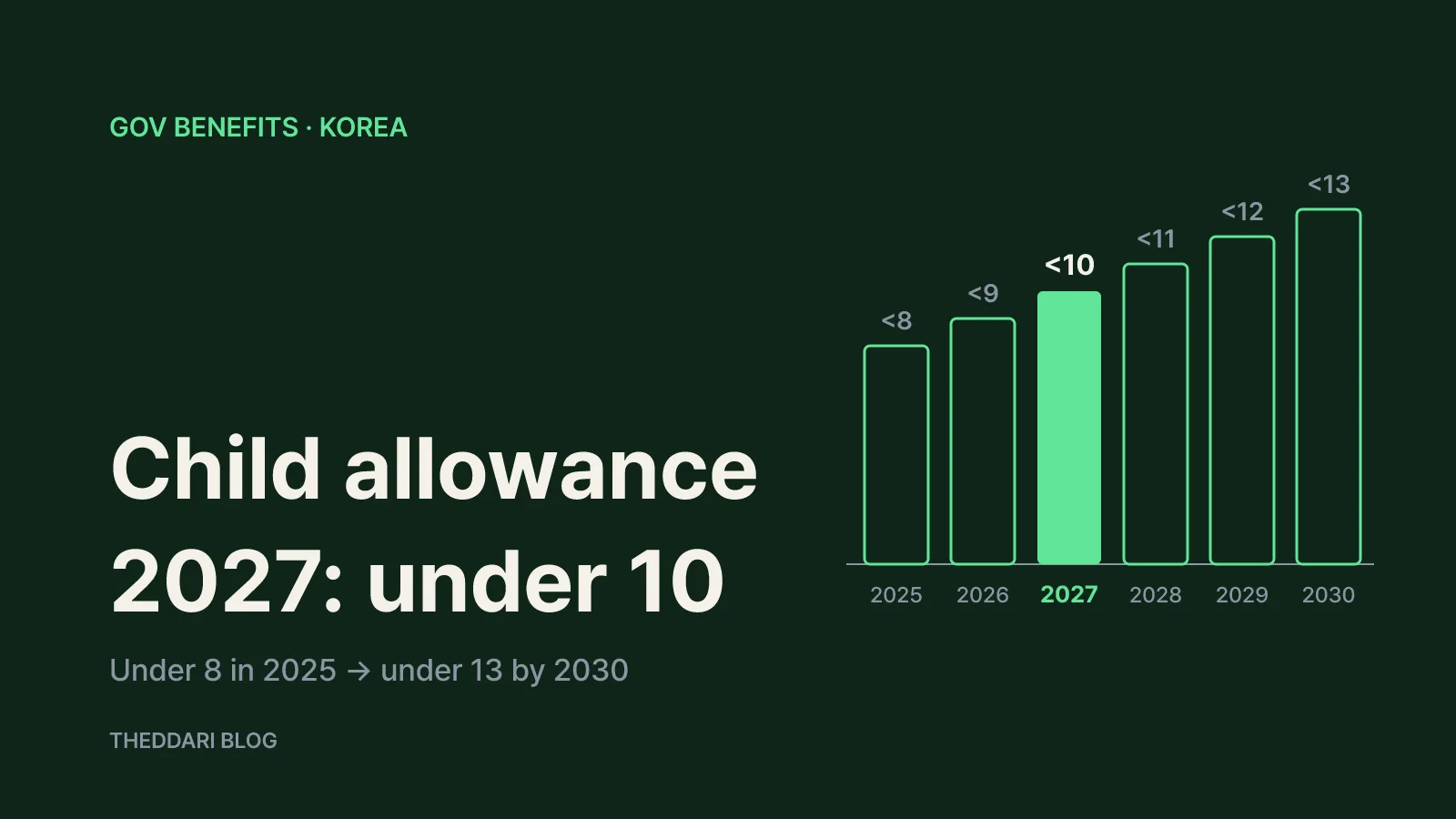
As of November 2026, Korea's child allowance (아동수당) will be paid to children under age 10 throughout 2027. A March 2026 amendment to the Child Allowance Act raises the age limit by one year every year, from under 9 in 2026 to under 13 by 2030. If your child already receives the allowance, you do not need to reapply when the limit rises, and children born in 2017 are protected by a special rule so their payments do not stop. The monthly amount now ranges from KRW 100,000 in the Seoul metropolitan area to as much as KRW 130,000 in designated depopulation areas.
This guide is based on the Ministry of Health and Welfare's policy briefing and its child allowance program page. It is written for parents in Korea, including international and returning families, who want a clear answer to one question before the new year: will my child still be paid in 2027?
Korea child allowance age limit for 2027: under 10
Until 2025 the allowance went to children under 8 at KRW 100,000 a month. The amended law, passed by the National Assembly on March 1, 2026 and promulgated on March 20, lifts the limit one year at a time (Yonhap):
← Swipe to see more
| Year | Eligible children |
|---|---|
| Through 2025 | Under 8 |
| 2026 | Under 9 |
| 2027 | Under 10 |
| 2028 | Under 11 |
| 2029 | Under 12 |
| 2030 onward | Under 13 |
Ages here are international (Western) ages, not the traditional Korean age count. "Under 10" in 2027 simply means the child has not yet had a 10th birthday. The ministry's program page, last updated on March 31, 2026, lists the target group as "all children under 9," and that threshold moves up by one year in January 2027.
There is no income or asset test. The ministry describes the benefit as going to all children in the eligible age range, so a raise or a second income in the household will not cut off your child's payment. Nationality and resident registration requirements still apply to the child, so families with a child of foreign nationality should confirm their situation with the local community service center (행정복지센터).
Monthly amount: KRW 100,000 to 130,000 depending on where you live
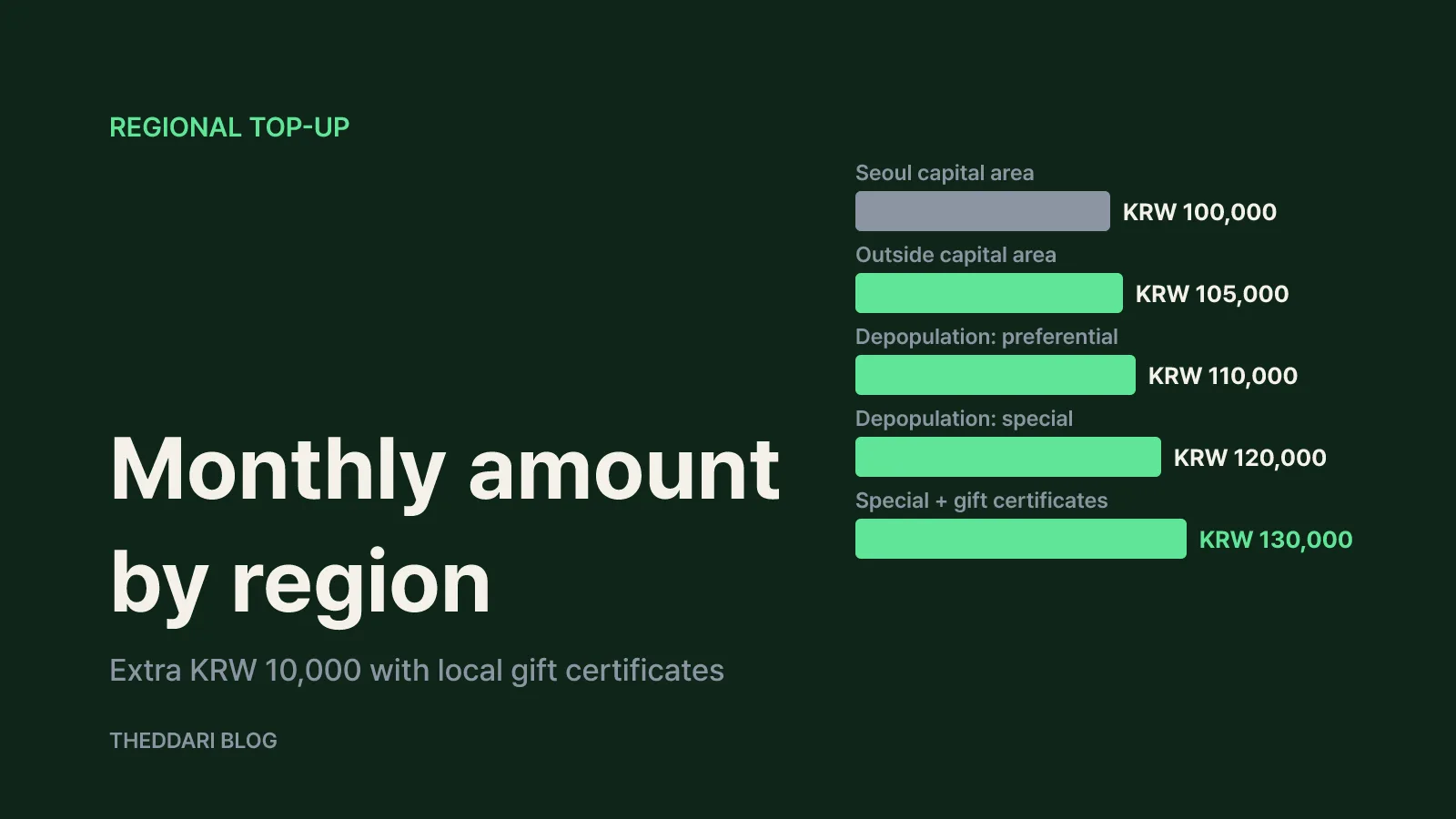
The second change in 2026 is a regional top-up. Children in the Seoul metropolitan area still receive KRW 100,000, while children elsewhere receive more (policy briefing):
- Seoul metropolitan area: KRW 100,000 a month
- Outside the metropolitan area (excluding depopulation areas): KRW 105,000
- Depopulation area, "preferential" tier: KRW 110,000
- Depopulation area, "special" tier: KRW 120,000
- Depopulation areas that pay in local gift certificates by ordinance: an extra KRW 10,000 on top
That is why the ministry summarizes the benefit as KRW 100,000–130,000 per child per month. The KRW 130,000 maximum applies only to a special-tier depopulation area that chooses to pay in local gift certificates (지역사랑상품권). Whether a city or county pays in certificates is decided locally through an ordinance after hearing from residents, so some depopulation areas may continue to pay cash only (Yonhap).
The tier depends on where the child lives, and the list of preferential and special areas is set by ministry notice. The most reliable way to confirm your tier is to ask your community service center or check the actual deposit in your Bokjiro payment history. If you move out of the capital region, watch your bank deposits for a month or two after registering the move.
The regional top-up applies retroactively from January 2026 and has been reflected from the April 2026 payment, which is why many families outside Seoul saw a lump-sum difference for January to March.
Born in 2017 or 2018: will payments continue in 2027?
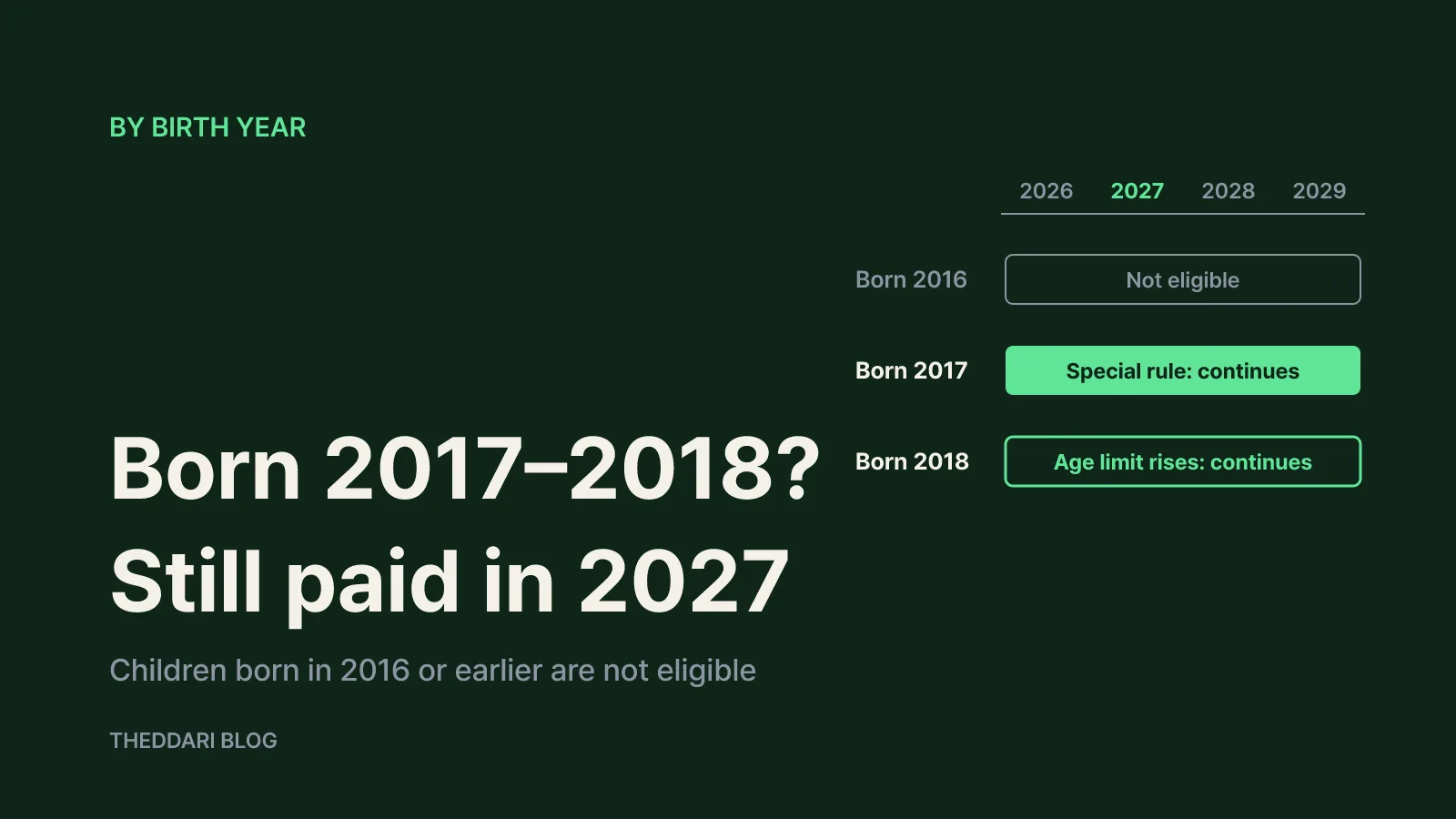
This is the question that causes the most confusion at year-end. The short answer: children born in both years keep receiving the allowance in 2027, but for different reasons.
A child born in 2018 turns 9 during 2027. Because the 2027 limit is under 10, the child stays eligible after the birthday. In 2028 the child turns 10, but the limit that year is under 11. Because the threshold rises in step every year, children born in 2018 or later keep receiving payments without a gap until the under-13 limit is fully in place.
A child born in 2017 is different. They turn 10 during 2027, which is above that year's limit, so payments would normally stop on the birthday. The amended law includes a special provision so that 2017-born children are paid without interruption until age 13 (Yonhap). According to a clause-by-clause summary of the law, this rule sits in the law's supplementary provisions and pays 2017-born children for every month from 2026 through 2029 regardless of age.
Children born between January 2017 and March 2018, whose payments had already stopped at age 8 before the amendment, received back payments from January 2026 in a single April payment (policy briefing). Children born in 2016 or earlier are not covered by the expansion and will not be eligible in 2027.
Who needs to apply and who does not
The ministry describes two paths:
- Children whose payments stopped because of age: once their payment records are confirmed, payments resume automatically without a new application.
- Children who have never received the allowance: a new application is required through Bokjiro or a local community service center.
If your child is already being paid every month, you do not need to do anything when the limit moves to under 10 in January 2027. Situations that usually require a new application include:
- A newborn whose allowance has not yet been requested
- A child who lived abroad for a long time and never applied after returning to Korea
- A child whose guardian previously chose not to apply
You can apply online through the Bokjiro website or app, or in person at a community service center. The ministry lists both "a visit to the community service center or online through Bokjiro (PC or smartphone)."
If the guardian has changed or you need a different bank account, update the application details. Automatic payments use the guardian and account already on file, so a closed account can delay the deposit. Updating it before the end of the year avoids that problem.
Payment date, back pay and suspension: a year-end checklist
The allowance is paid on the 25th of each month, or the previous business day if the 25th falls on a Saturday or public holiday. If you apply within 60 days of birth, counting the day of birth, payments are made back to the month of birth; after that, payments start from the month you apply (law summary). Applying at the same time as registering the birth is the safest option.
Payments are suspended if the child stays outside Korea for 90 days or more. If you are planning an extended stay abroad, ask your community service center about the suspension and how payments restart after you return.
Before the new year, it is worth checking:
- Your child was born in 2017 or later (children born in 2016 or earlier are not eligible)
- The January–March 2026 back pay arrived from April 2026
- Outside the capital region, the monthly deposit is above KRW 100,000
- The guardian and bank account details in Bokjiro are current
- Any newborn sibling was registered for the allowance within 60 days
Some government service listings have reportedly kept the old "under 8" wording. When sources disagree, rely on the Ministry of Health and Welfare's program page and policy briefing, and confirm with the Welfare Call Center at 129 or your local community service center.