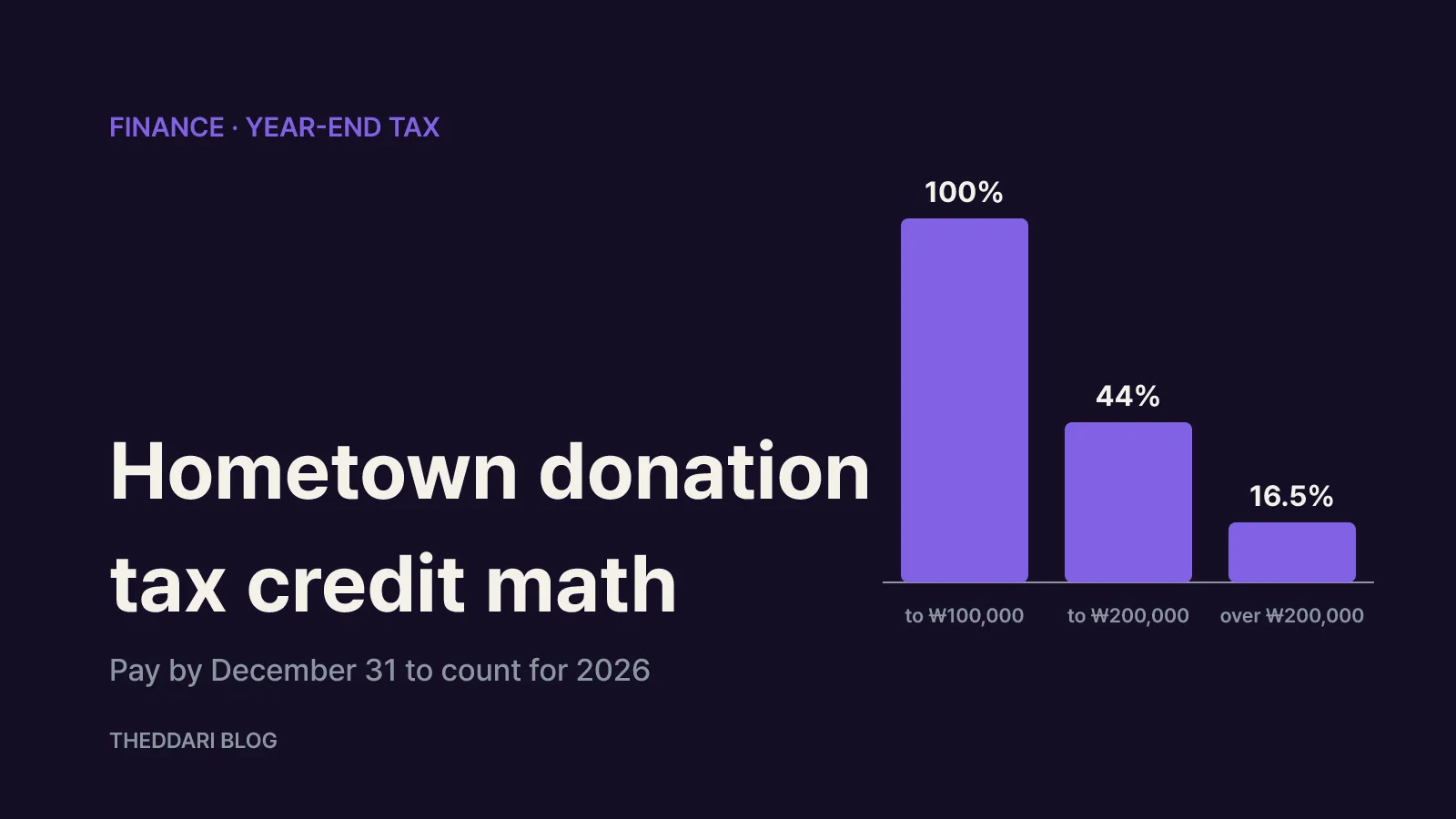
As of November 2026, a Hometown Love Donation made in Korea this year is credited against your tax bill at 100% for the first ₩100,000, 44% for the portion between ₩100,000 and ₩200,000, and 16.5% for anything above ₩200,000 (these rates include local income tax). On top of that, the local government you donate to gives you gift points worth up to 30% of the donation. To count for the 2026 tax year, the payment has to be completed by December 31, and the record flows into year-end tax settlement without extra paperwork. Below is the bracket math, what each common amount really costs you, the situations where the credit shrinks to zero, and what the proposed 2027 changes would mean.
What the Hometown Love Donation scheme is and who can use it
The Hometown Love Donation (고향사랑기부제) lets an individual donate to a Korean local government other than the one where they are registered as living. In return the donor gets an income tax credit and a regional gift, often local produce. Despite the name, the recipient does not need to be your actual hometown. According to the official Gohyang Sarang e-eum guide, only individuals can donate (companies cannot), and both your registered city or county and the province or metropolitan city above it are excluded. If your resident registration is in Seocho-gu, for example, you cannot give to Seocho-gu or to the Seoul Metropolitan Government, but you can give to any other city, county or province. The annual cap is ₩20 million per person.
The credit only helps if you pay Korean income tax, because it is subtracted from the tax you owe. That makes the scheme most relevant to salaried workers who go through year-end tax settlement (연말정산) with their employer, and to self-employed people who file a comprehensive income tax return.
How the 2026 brackets are calculated
The credit is not one flat percentage of the whole donation. Your annual total is split into slices, and each slice gets its own rate. Article 58 of the Restriction of Special Taxation Act sets the national income tax portion as follows:
- Up to ₩100,000: donation × 100/110
- ₩100,000 to ₩200,000: the excess × 40/100
- ₩200,000 to ₩20 million: the excess × 15/100, or 30/100 for donations to a declared special disaster area within the prescribed period
The official guide quotes rates that add local income tax, which is 10% of the income tax amount. That is why you will see 100%, 44% and 16.5%, and 33% above ₩200,000 for gifts to a special disaster area within three months of the declaration. The statute and the guide are describing the same credit; one shows income tax only and the other shows the combined total.
The 44% slice is new for 2026. The guide marks it as an increased rate that applies to donations from 2026 onward. A Yonhap fact-check from November 2025 shows that under the old rules everything above ₩100,000 earned 16.5%, so a ₩200,000 gift produced a ₩116,500 credit. For a 2026 gift of the same size, the credit is ₩144,000. If you settled on an amount based on last year, it is worth recalculating.
Brackets are applied to your total for the year, not to each gift. If you gave ₩100,000 to one county in March, a second ₩100,000 to a different county in December starts in the 44% slice. Gift points, by contrast, are tracked separately for each local government.
What common amounts actually cost you
Here is the 2026 credit, the maximum gift points and the net cost after the credit for four typical amounts:
← Swipe to see more
| Annual donation | Tax credit (incl. local tax) | Gift points cap (30%) | Net cost after credit |
|---|---|---|---|
| ₩100,000 | ₩100,000 | ₩30,000 | ₩0 |
| ₩200,000 | ₩144,000 | ₩60,000 | ₩56,000 |
| ₩500,000 | ₩193,500 | ₩150,000 | ₩306,500 |
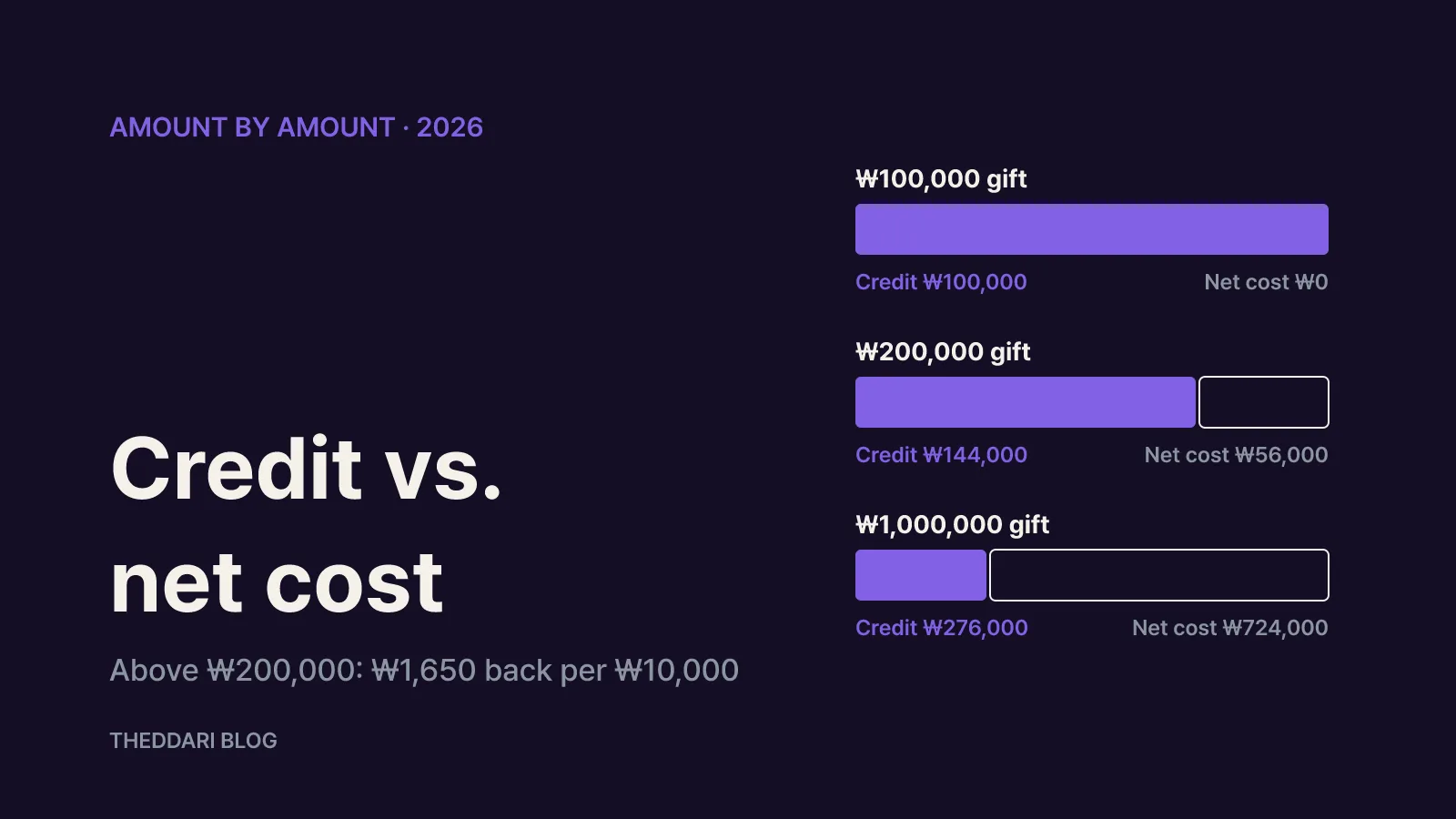
| ₩1,000,000 | ₩276,000 | ₩300,000 | ₩724,000 |
The ₩500,000 row matches the worked example in the Ministry of the Interior and Safety press release (₩100,000 × 100% + ₩100,000 × 44% + ₩300,000 × 16.5% = ₩193,500). The ₩1,000,000 row matches the official guide's example of ₩276,000.
The pattern is clear. Up to ₩100,000 the whole donation comes back as a tax credit. At ₩200,000 your net cost is ₩56,000 while the gift points can reach ₩60,000. Past ₩200,000, each extra ₩10,000 brings back only ₩1,650 in tax and up to ₩3,000 in points, so amounts above that level make more sense when you genuinely want to support a region or will use its gifts.
Gift points are capped at 30% of the donation, stay valid for five years and can be accumulated, but they can only be spent on gifts from the local government you donated to.
The December 31 cutoff and how the credit reaches your return
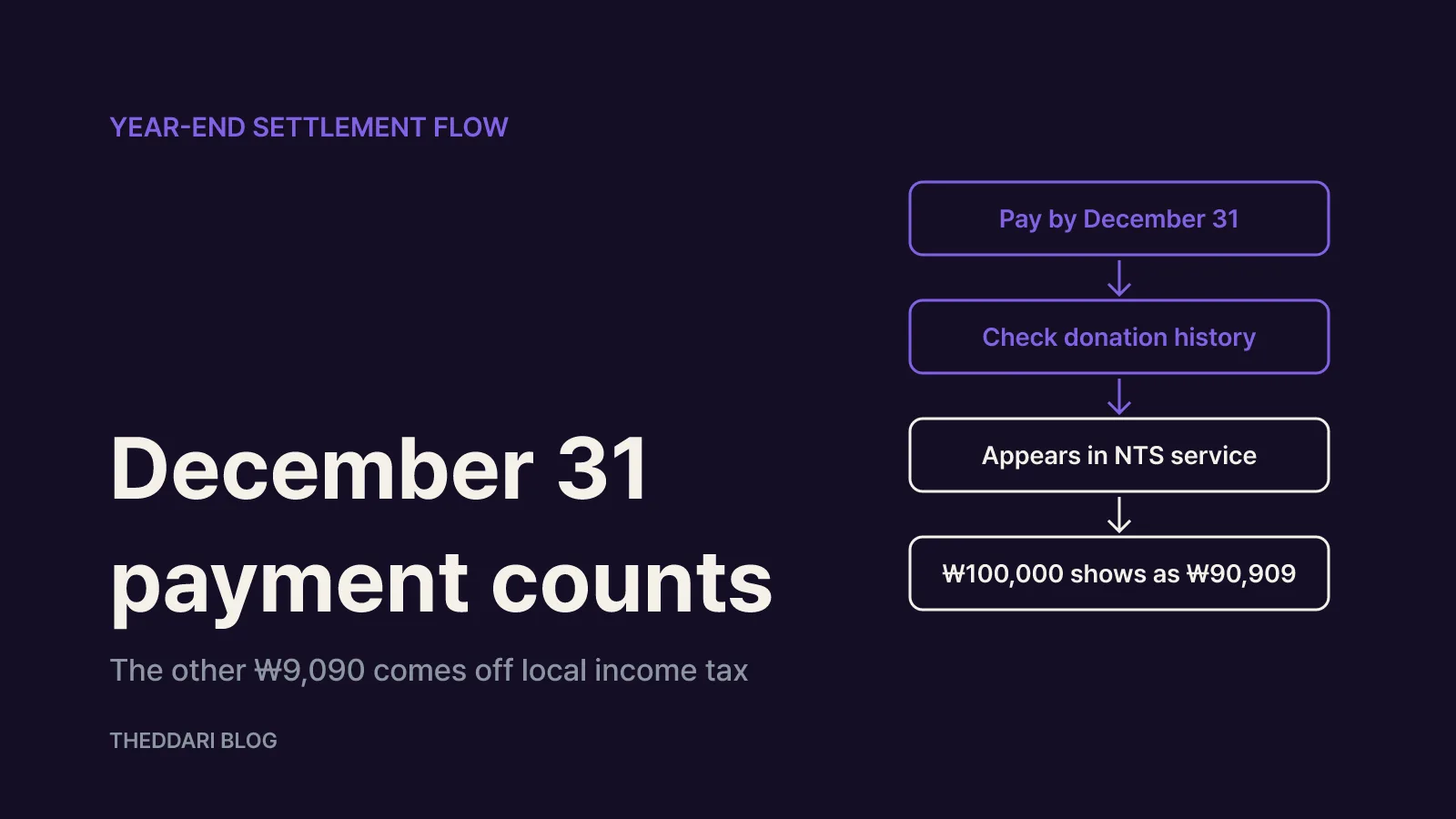
Article 58 credits the donation in the tax year in which it was paid. For the 2026 tax year, payment must be completed by December 31, 2026; anything paid on or after January 1 counts toward the following year.
The online donation steps on Gohyang Sarang e-eum are: sign up, log in, choose a recipient, pay, and pick your gift. During the donation step you enter the back half of your resident registration number so the site can confirm your address and hide ineligible recipients. Donations to Seoul are paid through the ETAX screen, while the other provinces use a separate payment window. Afterwards, open My Page and check the donation history. If a payment was interrupted, the donation is not complete; the guide tells you to use the donate-again option in your history to finish it. With traffic peaking at year-end, paying a few days early and confirming the status is the safer plan. The guide also lists several bank apps, including KB Kookmin, Shinhan, IBK, Hana, NH NongHyup and Kwangju Bank, plus private platforms such as Wello, as alternative routes.
You do not need to submit receipts yourself. According to Yonhap, the local government issues the receipt automatically and the amount appears in the National Tax Service's simplified year-end settlement service. That screen shows only the national income tax portion, so a ₩100,000 donation appears as ₩90,909, with the remaining ₩9,090 credited against local income tax. A smaller number on screen does not mean anything is missing.
Self-employed donors handle it in their comprehensive income tax return instead. The statute applies the same credit to the first ₩100,000 for business owners, but treats the excess as a deductible expense within their income after loss carryforwards, so the 44% and 16.5% figures do not translate directly.
When the credit shrinks or disappears
- No tax, no credit. The credit cannot exceed your computed tax for the year, and unused amounts are not carried forward. Yonhap's example: if your final tax is ₩50,000 and you donate ₩100,000, the other ₩50,000 is simply lost. Check last year's withholding statement before giving a larger amount.
- Donor only. The credit applies only to the person who paid. A gift in a non-earning spouse's name cannot be moved onto your settlement.
- Disaster-area timing. The 33% rate applies only within three months of a special disaster declaration and only to the slice above ₩200,000. For ₩1,000,000, that means ₩408,000 instead of ₩276,000.
- Address changes. Eligibility follows your registered address, so if you move and register a new address before donating, your new city or county and its province become off-limits.
The proposed 2027 regional rates
The Ministry's August 10, 2026 release says the government's 2026 tax reform plan would, from 2027, vary the credit on donations above ₩100,000 by region type: the capital area, non-capital metropolitan cities, other non-capital areas, and preferred non-capital areas. In its example, a capital-area resident giving ₩500,000 to a preferred non-capital area would receive ₩237,500 (₩100,000 × 100% + ₩100,000 × 55% + ₩300,000 × 27.5%) instead of ₩193,500. The plan still requires legislative amendment and National Assembly review, and it would apply from January 1, 2027. Donations paid by December 31, 2026 stay on the current 100%, 44% and 16.5% structure, and the first ₩100,000 remains at 100% in the proposal. Only the preferred-area rates were published, so check the final rates for other region types before planning 2027 gifts.
Quick checklist before you donate
- Add up what you have already given this year in your donation history.
- Confirm your expected tax is large enough to absorb the credit.
- Exclude your registered city or county and its province.
- For disaster areas, confirm the declaration date and the three-month window.
- Finish payment before December 31 and verify the completed status.
- Use gift points within five years at that region's gift shop.